AI Flow Engineering: Optimizing the Whole DevOps Lifecycle to Enable Enterprise-Scale AI-Powered Software Development
AI Flow Engineering transforms traditional DevOps by integrating autonomous AI agents across the entire software lifecycle, proactively optimizing planning, coding, testing, and deployment at scale.

 In an era where software is the backbone of competitive advantage, enterprises face mounting pressure to deliver high-quality applications faster, more securely, and at greater scale.
Traditional DevOps has delivered significant gains through automation and collaboration, but it often struggles with the complexity, variability, and cognitive load of modern development—especially when integrating AI capabilities.
AI Flow Engineering emerges as the next evolution. It combines principles of flow engineering (optimizing the end-to-end flow of work through value stream mapping and multi-step AI workflows) with pervasive AI integration—particularly agentic AI—across the entire DevOps lifecycle.
Rather than bolting AI onto isolated tasks, it designs intelligent, autonomous, and human-overseen flows that treat AI as a collaborative teammate. This enables organizations to achieve hyper-accelerated development, reduced toil, higher quality, and true enterprise-scale AI-powered software delivery.
The result is a shift from reactive automation to proactive, adaptive systems where AI agents plan, execute, monitor, and optimize across planning, coding, testing, deployment, operations, and feedback loops.
The Limitations of Traditional DevOps and the AI Imperative
Classic DevOps excels at CI/CD, infrastructure as code (IaC), and monitoring, but bottlenecks persist: manual code reviews, flaky tests, incident triage, context-switching, and misalignment between business needs and technical execution. At enterprise scale—with thousands of microservices, regulatory compliance, legacy systems, and distributed teams—these issues compound.
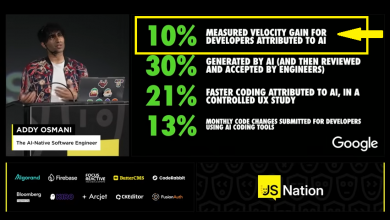
Generative AI and agentic systems address this by moving beyond code completion to full workflow orchestration. AI now handles planning, multi-file refactoring, test generation, anomaly detection, self-healing deployments, and even requirements clarification. Enterprises report velocity gains of 15%+ (and higher in top teams) as AI permeates the lifecycle.
Core Principles of AI Flow Engineering
- End-to-End Flow Optimization: Use value stream mapping to visualize and eliminate waste, then embed AI agents to maintain flow state.
- Agentic Collaboration: AI agents act as autonomous yet governed team members—perceiving, reasoning, acting, and reflecting—while humans retain oversight on high-stakes decisions.
- Iterative, Feedback-Driven Loops: Continuous learning from production data, user behavior, and telemetry feeds back into planning and coding.
- Governance, Security, and Compliance by Design: AI flows incorporate policy-as-code, automated vulnerability scanning, and audit trails.
- Human-AI Symbiosis: AI augments creativity and removes drudgery; engineers focus on architecture, innovation, and business value.
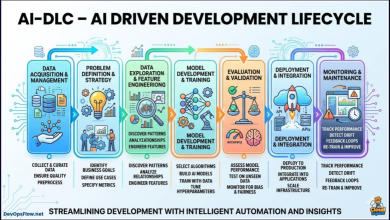
AI Across the DevOps Lifecycle
Planning and Requirements – AI agents analyze user feedback, market data, and historical tickets to generate user stories, prioritize backlogs, and even draft detailed specifications. Tools clarify ambiguities by asking targeted questions. Multi-agent systems simulate scenarios or balance trade-offs (e.g., cost vs. features).
Coding and Development – Beyond autocompletion (e.g., GitHub Copilot), agentic workflows enable repo-level context, multi-file edits, refactoring, and documentation generation. “Vibe coding” or natural language instructions translate into production-ready code. AI reviews pull requests, suggests improvements aligned with organizational standards, and enforces security/best practices.
Building and Testing – AI generates comprehensive test suites (unit, integration, performance, security), predicts flaky tests, and optimizes CI/CD pipelines dynamically. Autonomous agents can triage build failures or run exploratory testing. Predictive analytics forecast integration risks.
Deployment and Release
Intelligent canary deployments, feature flags, and rollout strategies adapt in real-time based on telemetry. AI agents handle rollback decisions or progressive delivery. GitOps enhanced with AI ensures infrastructure drifts are auto-corrected.
Monitoring, Operations, and Observability – AIOps platforms detect anomalies, root causes, and auto-remediate issues (e.g., scaling resources or applying patches). Agents correlate logs, metrics, and traces, then execute runbooks or notify teams with contextual summaries. Predictive maintenance reduces downtime.
Feedback and Iteration – Post-deployment, AI synthesizes telemetry, user analytics, and business KPIs to recommend improvements or new features, closing the loop seamlessly.
Conclusion
By 2026 and beyond, AI Flow Engineering will mature with more sophisticated agents, better multi-agent collaboration, and deeper integration of reasoning models. We will see “AI-native” organizations where software evolves continuously in response to real-world signals, with humans steering strategic direction. Challenges around alignment, explainability, and ethical AI will remain central.
AI Flow Engineering is not just an incremental improvement—it is a fundamental reimagining of how enterprises build and operate software. By optimizing the entire DevOps lifecycle with intelligent, flowing AI systems, organizations can unlock unprecedented speed, quality, and innovation at scale. The winners will be those who treat AI as a core engineering discipline: designing robust flows, governing responsibly, and empowering humans to do their best work.
Leaders who invest now in flow mapping, agentic capabilities, and cultural adaptation will dominate the AI-powered software era. The infrastructure of tomorrow is being built today—intelligently, autonomously, and at flow.